A month or so ago I started a new "Nyack Backyard" blog on Tumblr. I've decided I like the format better there. It's much easier to post from your phone and upload photos, share them on Facebook and Twitter, and reblog and things of interest from others. I may still cross post longer writings here. Below is a link to the Tumblr blog. I hope you'll follow me there and let me know where you are so I can follow you there and on Instagram and Twitter too (where I am nyackbackyard). Don't even bother with the Nyack Backyard Facebook page. I may even take it down because I discovered that most posts aren't visible to most followers. What's up with that??
www.nyackbackyard.tumblr.com

Monday, July 8, 2013


Wednesday, May 22, 2013
Hero Worship


Spiderman became my son's ultimate playmate -- when the movie came out that year, his likeness was everywhere. He received Spiderman shoes, shirts, sheets, cups, and pajamas as gifts from relatives. He ran around the house spinning webs and swinging from couch cushion to couch cushion. There was no question what he would be for Halloween. But Halloween came and went, and the Spiderman costume didn't come off. By Christmas it was hideously stained, the seat was threadbare, and the seams were ripping. We had to tell Spidey that his costume "blew away" one windy night when it fell apart in the wash. "Can I look on the roof for it?" he asked.
We made a trip to Disney World a few months later, and by the end of our day in the Magic Kingdom, Buzz Lightyear was his new favorite character. It was time to pick out a souvenier, and a Buss Lightyear costume had his attention. Since he had never quite gotten over the loss of his Spidey costume, we decided to splurge on it.
A few minutes later we were waiting in a huge empty parking lot outside the gates of the Magic Kingdom for the shuttle bus back to our hotel. "Can I put my costume on now?" my son asked. "Please? Please, can I put it on now? I'm gonna be Buzz Lightyear!"
Before we knew it, the costume was out of the bag. He put it on over his clothes. He sailed around and around the parking lot yelling "TO INFINITY AND BEYOND!" He looked as if his feet truly were about to leave the pavement. Then, they truly did. They slipped out from under him so that he landed backside first in a puddle of black bus grease. We watched him struggle with his embarrasssment, trying to decide whether to cry or not. In the end, he decided that it would be more fun to continue, and, after being convinced that the grease stain was a "special flying potion," he persisted in his quest for the alternate universe.
On the bus he sat next to a little girl in a princess costume, also about 3 years old. She was thrilled to be sitting by Buzz Lightyear. She held his hand and asked to kiss him. Romance bloomed on the way to the Ramada. When it was time to get off the bus, I watched him swagger down the aisle, the costume's "jet engines" slightly askew, the black grease now fully soaked into the seat. When he reached the end of the aisle, he turned to ask the bus driver a question, lost his balance and toppled backwards down the steps of the bus onto the pavement. He looked stunned, but then, finally, more out of exhaustion and embarrassment than injury, he broke down and cried with long, deep sobs. I picked my fledgeling wonder boy up from the concrete and carried him inside.
Wonder Boy turned 13 years old yesterday, and most signs of Spidey and Buzz have disappeared from his room. However, there is still a set of Spiderman sheets still in use on his twin bed. Yesterday he said to me "Mom, can I get some new sheets? Do you really think a 13 year old should be sleeping on Spiderman sheets?"
"Why not?" I said. Now that he's a teenager, he needs those superpowers more than ever.
Saturday, March 9, 2013
Betsy's New Friend

Sunday, February 24, 2013
Nest
 |
| Male Cardinal |

While the garden is sleeping, we're entertained by the birds. Betsy (my poodle) gets her share of thrills from the birdfeeder, too. As soon as she sees me picking up my camera, she runs to the window, knowing that the action is picking up. Here are a few photos of this year's visitors.
 |
| Blue Jay |
 |
| Looking for sunflower seeds. |
 |
| I'm guessing this is a young Song Sparrow |
 |
| Female Cardinal |
 |
| Downy Woodpecker |
 |
| White-breasted Nuthatch |
 |
| Watching for poodles on patrol. |
 |
| European Starling |
 |
| Male House Sparrow |
I read this poem about birdwatching recently and just had to share it. I love what it says about grief, renewal, perseverance and faith. The idea of being happy with what you have and keeping on when it seems like everyone else is much further along, even if you finish last. I especially like the line "But when was there suddenly mass?" because it applies so nicely to gardening and seed starting. Go away for a few days and forget, come back, and there is suddenly mass. When did that happen?
Nest
A bird was making its nest.
In the dream, I watched it closely:
in my life, I was trying to be
a witness not a theorist
The place you begin doesn't determine
the place you end: the bird
took what it found in the yard,
its base materials, nervously
scanning the bare yard in early spring;
in debris by the south wall pushing
a few twigs with its beak.
Image
of loneliness: the small creature
coming up with nothing. Then
dry twigs. Carrying, one by one,
the twigs to the hideout.
Which is all it was then.
It took what there was:
the available material. Spirit
wasn't enough.
And then it wove like the first Penelope
but toward a different end.
How did it weave? It weaved,
carefully but hopelessly, the few twigs
with any suppleness, any flexibility,
choosing these over the brittle, the
recalcitrant.
Early spring, late desolation.
The bird circled the bare yard making
efforts to survive
on what remained to it.
It had its task:
to imagine the future. Steadily flying around,
patiently bearing small twigs to the solitude
of the exposed tree in the steady coldness
of the outside world.
I had nothing to build with.
It was winter: I couldn't imagine
anything but the past. I couldn't even
imagine the past, if it came to that.
And I didn't know how I came here.
Everyone else much farther along.
I was back at the beginning
at a time in life we can't remember
beginnings.
The bird
collected twigs in the apple tree, relating
each addition to existing mass.
But when was there suddenly mass?
It took what it found after the others
were finished.
The same materials--why should it matter
to be finished last? The same materials, the
same
limited brown. Brown twigs,
broken and fallen. And in one,
a length of yellow wool.
Then it was spring and I was inexplicably
happy.
I knew where I was: on Broadway with my
bag of groceries.
Spring fruit in the stores: first
cherries at Formaggio. Forsythia
beginning.
First I was at peace.
Then I was contented, satisfied.
And then flashes of joy.
And the season changed--for all of us,
of course.
And as I peered out my mind grew sharper.
And I remember accurately
the sequence of my responses,
my eyes fixing on each thing
from the shelter of the hidden self:
first I love it.
Then, I can use it.
Louise Gluck, Poetry, “Nest,” The New Yorker, February 8, 1999, p. 56
Saturday, February 16, 2013
A Seed Starting Autogarden

Every year I try to step up my game and get a little better at starting seeds. Last year I bought a small grow light kit for my closet. This year I bought another one and started two trays in there. This is a big step up for me, but nothing like the gargantuan leap of the snazzy seed starting autogarden designed by my friend Dr. Duncan Bell, who has his own brilliant blog here.
Knowing of the seed saving and starting mania that I am possessed by this time of year (I collect and buy a LOT of seeds!), Duncan kindly made one level of his autogarden available to me. I'm doing a small experiment, which I'll talk about in another post, but first I want to tell you how the autogarden works. The secret is wicks!
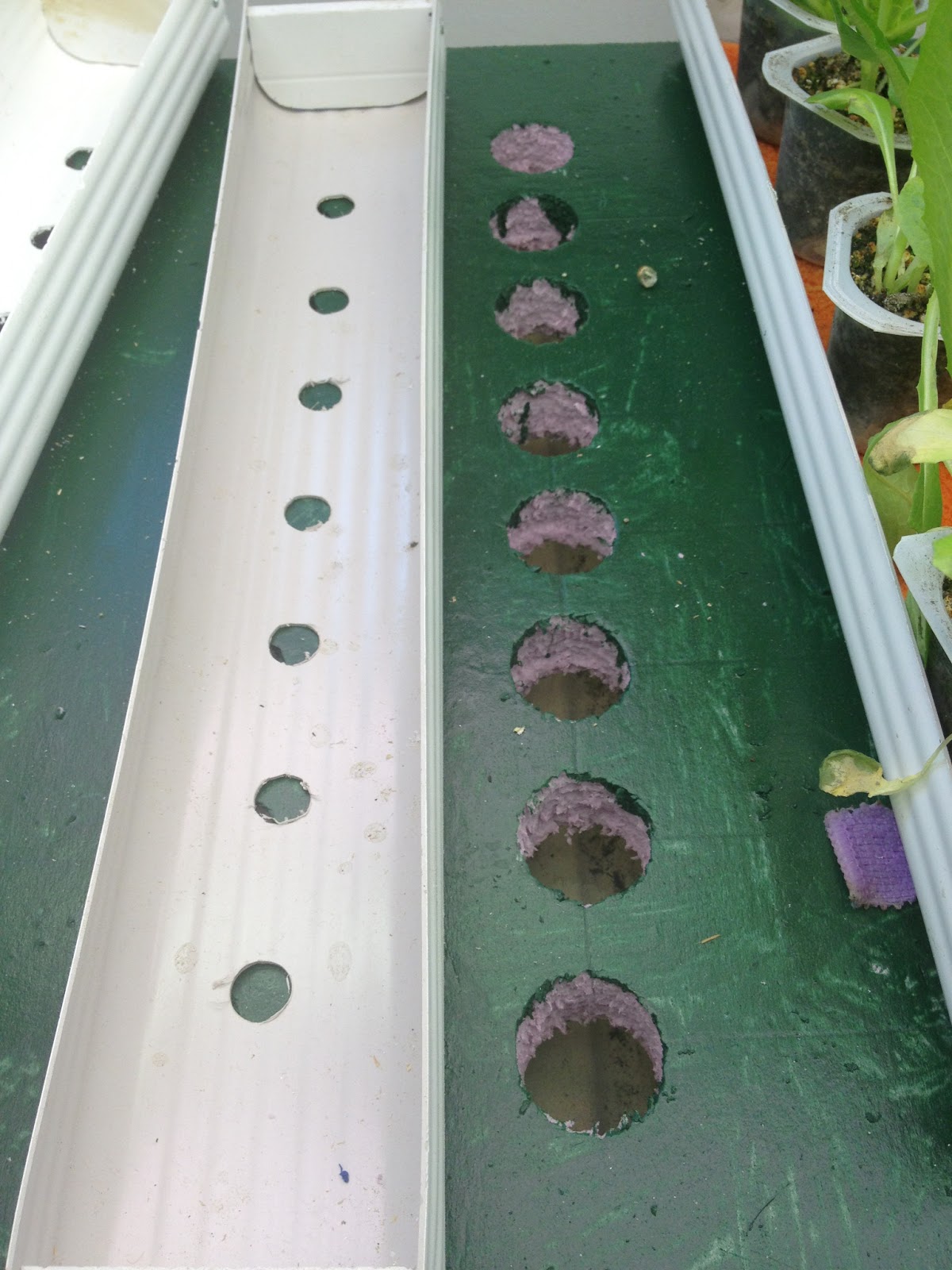
Trays are made from downspouts that measure 18" long and 3" wide. Seven holes are drilled in the bottom of each tray.
The holes are threaded with wicks cut from microfiber dishcloths.


Once filled with soil and seeded, the trays are placed directly on top of another set of wicks that carry water up from a reservoir below. The reservoir is filled by tubes fed by plastic bottles hung above the trays.


A floating element made from foam and weather stripping controls the flow of water through a hollowed-out disposable pen into the reservoir.

This system of piping, tubes and wicks does a fantastic job keeping the soil in perfectly moist condition.
Now awaiting little leaves!
Other posts about Autogardens.
More From Dr. Duncan Bell
A Self-Watering Autogarden
Dr. Bell's Autogardens Blog
Monday, February 4, 2013
Ten Things I Learned from Dr. Diana Reiss


1) Dolphins are odontocetes - odontocetes are toothed mammals that preceded the mysticetes (non-toothed whales) that glean their food with bony plates. They share their evolutionary ancestry with cows and deer, and are closely related to the hippo.
2) Dophins have been known to save people in distress. Since ancient times there have been legends about people who have been saved by dolphins. One recent account involves Elian Gonzalez, whose experience in 2000 ignited an international custody battle, was monitored by dolphins while he clung to an inner tube, waiting for help to arrive.
3) A dolphin recently presented his fin, tangled in fishing line, to a diver, requesting help.
4) The dolphin brain is second only to humans when measuring "encephalization quotient," or the relative measure of brain size to body. The dolphin has a larger encephalization quotient than apes.

5) U.S. aquariums have not taken dolphins from the wild for 20 years.
6) Dolphins will manipulate and create toys. They play with seaweed, carry rocks, and most amazingly, have been documented creating their own "bubble ring" toys with their blow holes.
7) In their underwater societies, dolphins will fish cooperatively, working together to create rings out of mud or bubbles to corral fish, or chase them onto shore, where they can easily be captured.
8) Dolphins have learned to recognize visual forms/symbols and associated sounds, and request specified toys by hitting underwater keyboard. They have imitated the sounds by vocalizing while playing with the requested toys.
9) Dolphins can recognize themselves in a mirror. A dolphin who has been marked will quickly recognize it in the mirror. Only chimps, dolphins, elephants and crows have demonstrated MSR (mirror self recognition).
10) Dolphins have been found in the Hudson River and Gowanus Canal. In June of 2012, a lone bottlenose dolphin was seen swimming in the Hudson River. It passed away a few days later. Just last week, a sick dolphin was also found in the Gowanus Canal. It also died from unknown causes.
"It is not uncommon for large marine animals like dolphins and whales to swim right up to the openings of New York’s waterways, swept in during high tide and out again with the next high tide. Most of the time, the animals come and go without incident."
- The New York Times 1/26/13

Dr. Reiss believes that dolphin shows are not ideal, because they tend to focus mainly on physical prowess, rather than their cognitive and social skills, but feels that some shows can be an effective way to educate and involve people with dolphin conservation. Dolphin slaughter still goes on in Japan (as depicted in "The Cove") despite the story being exposed in the film. Scientific facts are powerful and can help change policy. Dr. Reiss suggests that we write our state department, and urge them to request the slaughters be stopped through diplomatic channels. Learn more at www.actfordolphins.org.
Follow the links to learn 10 things from:
Susan Petro
Gretchen Rubin
Marie Winn
"Little Heathens"
Richard Louv
"Ecological Intelligence"
Temple Grandin
Sunday, January 27, 2013
Seeds in the Closet

Lettuce "Salad Bowl Blend" - Botanical Interests
Parsley "Italian Gigante" - Burpee
Cleome (saved from swap with community gardener Robin)
Zinnia (saved)
Cilantro (saved)
Savoy Cabbage (Baker Creek)
I used this "Pro Mix"
 It contains 75% to 85% peat moss, Perlite, Limestone and "wetting agent"(wonder what that is!)
Are you starting any seeds indoors this year? I'd love to know what you're growing.
Older posts about seeds:
Seedling Experiment
Making a Seed Starter From Recyclables
Subscribe to:
Posts (Atom)