Showing posts with label communal living. Show all posts

Sunday, October 7, 2012

Visit to The Pfeiffer Center


For years now I’ve wanted to visit The Pfeiffer Center, a biodynamic farm in Chestnut Ridge, NY, not far from here.  I finally had my chance last Sunday, during the Rockland Farm Alliance “Farm to You” Festival and Tour.    It was just one of the places visited that day, along with Cropsey Community Farm in New City, Bluefield Farm in Blauvelt and Hook Mountain Growers in Upper Nyack.

Apart from their attention to the lunar calendar, I wasn’t too familiar with biodynamic growing.  Biodynamic ideas originated with Rudolf Steiner in the 1920's, when he realized that conventional fertilizers weren’t maintaining soil quality.  Biodynamics takes organic farming a step further.  

From the Pfeiffer Center website:
“Steiner described an approach to plant and land care that combined novel techniques of building up healthy soil with a renewed awareness of all the forces at work in the farm organism: among and between the soil, plants, animals, and humans, as well as the cosmos itself.  Rudolf Steiner set forth the principles of a modern, organic agriculture that works with life-regulating processes and subtle catalysts such as trace elements and enzymes. He emphasized that each farm is an organism in its own right, with an organism's powers of self-healing.”

On Sunday, I was able to watch and take part in a biodynamic practice that has the potential to affect growth on their farm for years to come.  We made a composted manure “tea” solution, known as “Preparation 500” that will be sprayed on the crops and gardens.  The diluted preparation introduces beneficial microbes that both feed and protect the plants, stimulate growth and fecundity, and enrich the soil. 

We started with a pail full of hollow cowhorns.  We used spoons to fill them with fresh cow manure.  The cow horns are usually planted in the soil during the fall, around the time of the equinox, when the earth starts to withdraw into itself.   In the spring, they’re recovered, and the composted manure is used to make the solution. 

For this workshop, the staff had some already-composted manure ready to go, and the participants all had a part in stirring the compost into the water using paddles as well as bare hands. 


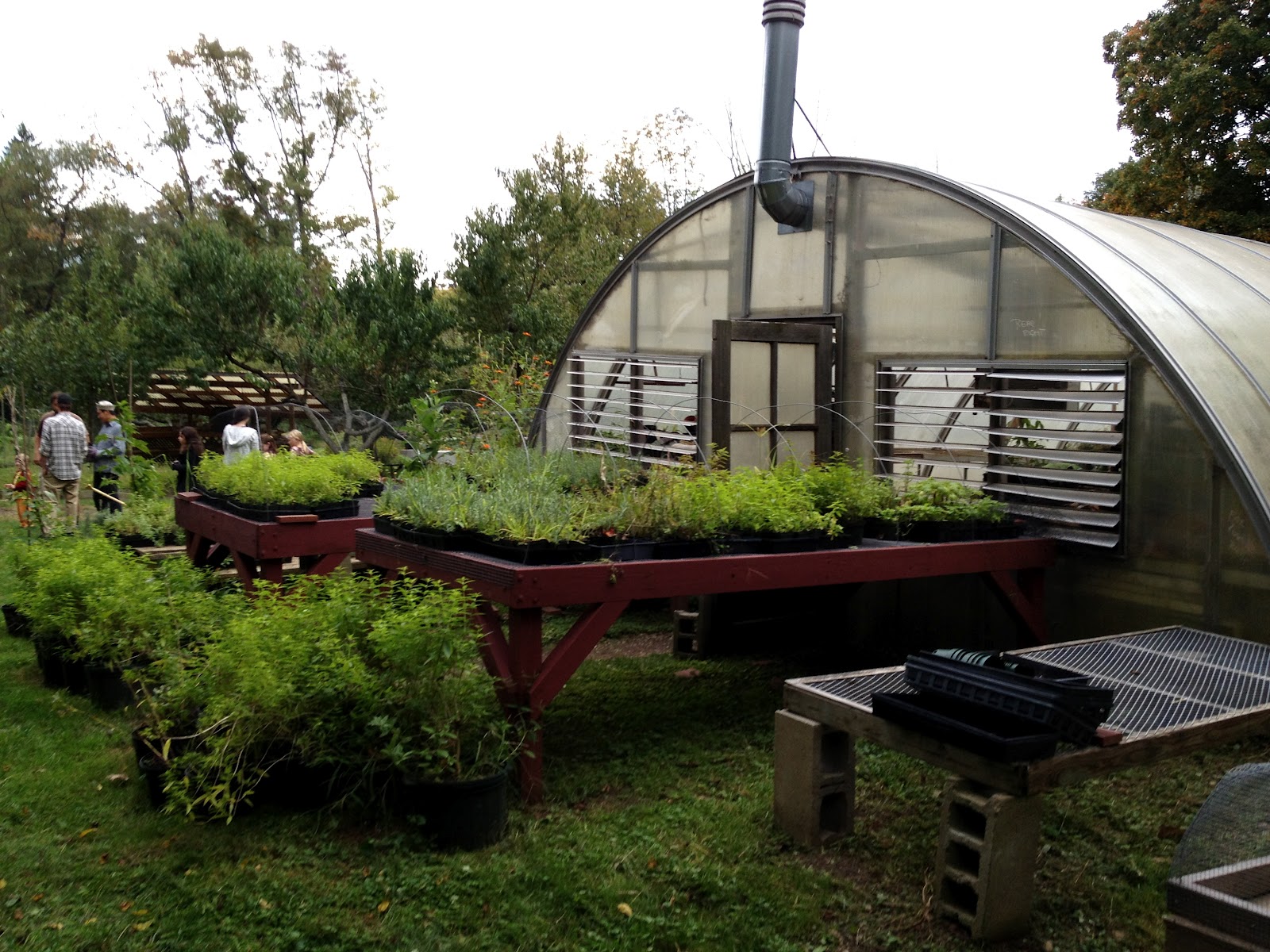
I also got a peek at their beautiful vegetable garden.   The site pictured here is only part of their farm.  They have a total of 70 beds, two horses, an orchard and berries, a greenhouse, compost piles, wood-fired oven, an apiary, and dye garden for a fiber craft studio.  They also have a seasonal farm stand that is self supporting and open on Monday and Thursday mornings. 


The Pfeiffer Center runs regular workshops that are open to the public. So much to learn here -  hope this visit was the first of many!

Tuesday, May 8, 2012

11 Things to Think About When Planning a Community Plot

Gardening is always a big experiment, and each season teaches us what NOT to do next year.  I've only been a member of the Nyack Community Garden for two years, but the first year was very educational for me.  Mostly, it was a year of watching other gardeners, observing their techniques, and talking with them about their successes and failures.  There's nothing truer than the advice of someone in the plot right next to yours.  After all, they're experiencing the same weather, soil and shade that you are -- or at least very close to it!   Below are some things I'll be considering as I plant my garden this year. 

1)  Shade-   How much say do you have in which plot you are assigned?  Can you choose a plot with more or less shade?  Before you plan your plot, visit the garden at different times of day and see where the shade falls.  If one side of your plot has a longer sun exposure, put your beans, squash and tomatoes there.  Plant lettuces and other less heat-tolerant plants in the shady areas.   Consider the shade that you’ll create if you plant tall plants such as sunflowers or teepees and how it might affect your neighbor’s plot.

The Great Squash Vine Massacre of 2011
2)  Boundaries – Decide how you’re going to separate your plot from the ones on either side.  In our garden, some use wooden boards, trenches, paths, cords, or wire fences.  A well-defined border can prevent disputes about weeds and other intrusions.

3)  Growing Up/Vines – When you’re short on space, as many community plots are, think about where you can put a trellis or teepee.  You may think you don’t have space for squash, but trellising can change that.  Another way to save space is by planting bush varieties, helping you avoid what has become known as The Great Squash Vine Massacre of 2011.

4)  Weeds – When you don’t weed your plot, you’re not the only one who has to deal with the consequences.  Get in there early. Don’t let weeds go to seed in a plot that you’re responsible for – the seeds will travel into your neighbor’s plot and create problems for them, too.

5)  Sowing vs. Plants – You might be limited by the dates when your garden opens and closes.  For example, you can't get a head start on your peas in March if your garden doesn't open til mid-April.  In some cases, it makes more sense to put in plants bought from a nursery rather than sow from seed.  When purchasing seeds, be sure to check the number of days to maturity – if it’s long, and your last frost date is late, you might have better luck putting in plants that have had a professional head start.

6) Whimsey –  Gnomes anyone?  I always appreciate a few pieces of well-chosen décor in my neighbor’s plots –  it can help others get a sense of your personality and aesthetic.

7)  Mulch – a hotly debated topic in our community garden.  Some insisting on plastic weed block, others using straw, wood shavings or nothing at all.  Some kind of mulch is helpful in conserving water and preventing weeds.

8)  Paths  - Often community plots are right next to each other.  How will you get around your plot without trampling it?  Some options include mulching, trenches, cords, stepping stones, boards.  If you opt for boards, be sure they’re not too narrow – it could be hard to get your balance.

  9)  Pollinators – a plot is never complete without a pollinator plant.  Some pretty ones that I’ve noticed making bees very happy are anise hyssop, cleome, and lantana. Think how much healthier the garden will be if every plot includes at least one.

   10) Watering – how far are you from the water source and how will you get the water into your plot?  Do you have an option to spray or will you hand water with a can?   If you’re spraying you might consider putting sturdier plants in front where they won’t be knocked over by forceful sprays.

11)Plant a row – Can you spare a row to help your local food pantry?  Our garden club donates an entire plot to this project, sponsored by the Garden Writers Association.   Locals can visit this website to find out where your extra fresh vegetables might be needed to help the hungry.  For those who aren't local, your cooperative extension can probably point you in the right direction.


Share your wisdom -- what have you learned that could be applied to community plots this year?


Saturday, August 28, 2010

Infinity Farm in New Mexico

Armando was among several we met during our trip who called New Mexico “The Land of Entrapment.” He's is originally from Buffalo, and, like my father-in-law, is one of the many transplanted residents from “back east” who have fallen in love with the wide skies and purple vistas here.  I can see why it would be hard for them to shake themselves free.

Infinity Farm and its sister farm nearby, Drangonfly Farm, are two of a growing number of small farms whose mission is to aquaint people with the pleasures of growing and eating fresh organic food and changing the way our children eat.

We met Armando at the farmers market and he invited us to visit his farm, where he’s worked for the past 3 years to become a sustainable producer for local restaurants and residents. Several times during my visit I was asked if I was a “wwoofer.”  WWOOF stands for World-Wide Opportunities on Organic Farms. WWOOFers exchange a half day of work on participating farms in exchange for food, and accommodation, and in return learn practical farming skills and gain experience. Infinity Farm often hosts woofers, and I got a taste that day of what it is like to be one.


Buona Fortuna! It was a rare, overcast, cool day when I was there. The day began with a tour of the farm. The Pecos River Valley, where this farm is located, is known to be among the most fertile areas in New Mexico. Many of these farms use a combination of river water and well water to irrigate their crops. A system of canals, known as acequias, are a used communally to bring river water to the fields.

Armando designed these bee hives using old milk tubs.


The greenhouse had loads of tomatoes workng hard on ripening. There was also a small orchard with plum, peach, apple and pear trees.


Two other volunteers, John and Betty, worked with Armando and I on Tuesday. We picked and weeded the tomatillo patch, where many have re-seeded themselves and gone wild.


Then we moved up to the “willow patch” where weeds had overtaken the onion patch. Some onions were ready to harvest.


I love this fence, handmade from willow branches. 

The visit closed with a lunch of fresh homemade sushi. Many thanks to Armando for his kindness and hospitality, and for putting up with my many questions about why this is that way and what to do about this or that pest!  His stand can be found at the Las Vegas, NM Farmer’s Market on Fridays.

Here is a link to a wwoofer’s blog, Fieldwork 2010

Thursday, December 11, 2008

10 Reasons to Buy Handmade at the Fellowship Community


The Poppytalk site has compiled 101 Reasons to Buy Handmade, but after spending time at the Fellowship Community’s annual Christmas Sale and Festival (in Chestnut Ridge, NY) I think I could come up with 101 reasons to do your holiday shopping there. Here are 10 to start with:

1) You Get to Look at the Chickens - they've got some purty ones.

2) They have toys


3) They have pottery and candles (and candle holders!).


4) You can eat there. This year there were some delicious Indian entrees and there's always good soups and excellent hummus. There's a common dining room where everyone sits to eat.

5) Joanne and Norma- I love being able to meet the people who made these gorgeous items, and sometimes see them year after year. Here are a couple of things I’ve purchased from Joanne.


And here’s what Norma made for me...


6) You'll hear music. In the dining room, there's always some live holiday tunes.


7) There are activities for the kids. Our girls made some felt ornaments, bead necklaces, origami, and elf decorating.


8) You can see a puppet show (not just for the kids- we grownups love them too)


9) They've got Stuff in Jars and Bottles made from what they grow in their garden.


10) You're supporting a wonderful community dedicated to care of the older person. The older people who live there often interact with younger residents, volunteers and students from the nearby Sunbridge College and Green Meadow Waldorf School. They believe that intergenerational social activities benefit people of all ages. Continuous learning and development at all stages of life is part of their mission.

And here's one reason NOT to shop there: The gifts are SO HARD to give away. I mean, how can I possibly part with this?


The festival is usually held on the first weekend of December every year. Put it in your 2009 calendar now!

Thursday, September 4, 2008

El Rancho de Los Golondrinas

Near Santa Fe we visited a living history museum much like Colonial Williamsburg or Sturbridge Village. El Rancho de Las Goldrinas re-creates surroundings and tasks of the settlers from Mexico in the early 1800s. We went on the "Josefina" tour, a tour just for kids that's based on the American Girl character. Some of the buildings at the ranch have been designed to replicate those in the books. Below are some photos showing ways that Josefina would have spent the day.

Here's the garden- it was about 3 times bigger than shown in this photo.


Weaving display. The settlers slept on the woven blankets.

Most homes had small altars where they prayed to the saints. It wasn't unusual to find a saint figurine turned to the wall in "punishment" if they didn't fulfill requests.


Here's the altar in the chapel. A gorgeous example of the art of Retablo (handpainted depictions of saints on wood).
Several families lived together on the ranch. Josefina might have been in charge of bringing water from the well each day,

Grinding flour for tortillas,


taking sheep to graze in the fields,

Weaving blankets for her family,
dyeing wool using natural sources, like flower petals and bugs.
gathering and preparing foods for drying and preserving during winter months,


Patching the cracked adobe walls with new mud.

A great place to visit if you're ever in Santa Fe!