Showing posts with label Ten Things I Learned. Show all posts

Monday, February 4, 2013

Ten Things I Learned from Dr. Diana Reiss


We're only beginning to understand how dolphins communicate and their surprisingly complex underwater relationships and societies.  Dr. Diana Reiss has spent decades studying how dolphins think, relate and play.  She's a professor of psychology at Hunter College in New York City and directs dolphin research at the National Aquarium in Baltimore.  She was also a consulting scientist for the Oscar-winning film "The Cove," and is author of the book The Dolphin in the Mirror. Dr. Reiss spoke at 92Y last Thursday night to an enthralled audience. Here are some highlights from her talk:

1)  Dolphins are odontocetes - odontocetes are toothed mammals that preceded the mysticetes (non-toothed whales) that glean their food with bony plates.  They share their evolutionary ancestry with cows and deer, and are closely related to the hippo.

2) Dophins have been known to save people in distress.  Since ancient times there have been legends about people who have been saved by dolphins.  One recent account involves Elian Gonzalez, whose experience in 2000 ignited an international custody battle, was monitored by dolphins while he clung to an inner tube, waiting for help to arrive.

3) A dolphin recently presented his fin, tangled in fishing line, to a diver, requesting help.

4) The dolphin brain is second only to humans when measuring "encephalization quotient," or the relative measure of brain size to body.  The dolphin has a larger encephalization quotient than apes.

5) U.S. aquariums have not taken dolphins from the wild for 20 years.

6) Dolphins will manipulate and create toys.  They play with seaweed, carry rocks, and most amazingly, have been documented creating  their own "bubble ring" toys with their blow holes.  

7) In their underwater societies, dolphins will fish cooperatively, working together to create rings out of mud or bubbles to corral fish, or chase them onto shore, where they can easily be captured.

8) Dolphins have learned to recognize visual forms/symbols and associated sounds, and request specified toys by hitting underwater keyboard.  They have imitated the sounds by vocalizing while playing with the requested toys.

9) Dolphins can recognize themselves in a mirror.  A dolphin who has been marked will quickly recognize it in the mirror.  Only chimps, dolphins, elephants and crows have demonstrated MSR (mirror self recognition).

10) Dolphins have been found in the Hudson River and Gowanus Canal.   In June of 2012, a lone bottlenose dolphin was seen swimming in the Hudson River.  It passed away a few days later.   Just last week, a sick dolphin was also found in the Gowanus Canal.  It also died from unknown causes.

"It is not uncommon for large marine animals like dolphins and whales to swim right up to the openings of New York’s waterways, swept in during high tide and out again with the next high tide. Most of the time, the animals come and go without incident."
                                                                                                  - The New York Times 1/26/13


Dr. Reiss believes that dolphin shows are not ideal, because they tend to focus mainly on physical prowess, rather than their cognitive and social skills, but feels that some shows can be an effective way to educate and involve people with dolphin conservation.  Dolphin slaughter still goes on in Japan (as depicted in "The Cove") despite the story being exposed in the film.  Scientific facts are powerful and can help change policy.  Dr. Reiss suggests that we write our state department, and urge them to request the slaughters be stopped through diplomatic channels.  Learn more at www.actfordolphins.org.


Follow the links to learn 10 things from:

Susan Petro
Gretchen Rubin
Marie Winn
"Little Heathens"
Richard Louv
"Ecological Intelligence"
Temple Grandin


Sunday, June 13, 2010

Ten Things I Learned from Dr. Susan Petro

If you ever have an opportunity to take a class or go on a "Botanical Walk" at Ramapo College with Dr. Susan Petro, don't even think about refusing. It can't exactly be called a nature walk because it was so much more -- history, literature, entomology, and ecology all had their moment.   There was even a culinary component. These are just a few highlights.

Our walk began with the Linden Tree in the parking lot.

1) Linden Trees (Tilia) are insect pollinated, so they can bloom AFTER the leaves appear.  Wind pollinated plants bloom before the leaves appear, because the leaves inhibit the flow of pollen. Tea, honey and scented oils are made from linden blossoms.  Our guide brought us sample of linden tea (which she served with some yummy homemade lemon madeleines!)

2) When White Clover (Trifolium repens) has been pollinated, the lower petals fold down.  That sends a message to pollinators not to bother with this one.


3) MADCAP HORSE is an acronym that helps you remember which trees and shrubs have opposite leaves so that you can identify them.
M  = Maple
A  = Ash
D = Dogwood
CAP = Caprifoliaceae - viburnums and honeysuckles
HORSE = Horse Chestnut

4) Spruce (picia) v. Fir (abies)- One way to identify conifers is to pull off a needle.  If it is a single needle (rather than several in a package) it is most likely a spruce or fir.  A spruce needle has 4 sides- "S" is for "Square" and "Spruce."  A fir needle is flat.  "F" is for "Flat" and "Fir."  You'll be able to tell the shape by rolling the needle between two fingers.

5) One legend says that Queen Anne's Lace (daucus carota) is so named because Queen Anne, a champion lacemaker from Denmark, challenged her ladies in waiting to a contest to see who could make the prettiest lace, and Queen Anne, being the queen, won. 

Queen Anne, Queen Anne, has washed her lace
(She chose a summer's day)
And hung it in a grassy place
To whiten, if it may.

Queen Anne, Queen Anne, has left it there,
And slept the dewy night;
Then waked, to find the sunshine fair,
And all the meadows white.

Queen Anne, Queen Anne, is dead and gone
(She died a summer's day),
But left her lace to whiten in
Each weed-entangled way!

By Mary Leslie Newton

6) Sassafras- (sassafras albidum) has 3 different leaves: One that looks like a mitten, one with three lobes, and one a simple oval.  The root was used to flavor root beer until it was discovered that the distilled oil causes cancer, and it was banned by the FDA.

7) Lichen
"Algae, you're a fungi, I think I've taken a lichen to you...."  Lichen are both algae and fungi living together.  Lichen are harmless to trees and very sensitive to air pollution.

8) St. John's Wort (Hypericum perforatum) produces an oil that, when consumed by cattle, makes them photosensitive.  When the plant overtook some California farmland, the cattle started getting terrible sunburns, and a special beetle had to be introduced to get it under control. 

9) Which Maple (acer) is this?  Squeeze the tip of the leaf twig. If a white milky extract comes out, it's a Norway Maple.  If none, it could be a Red or Sugar Maple.  Red Maples have teeth along the edge.  Sugar Maples do not.  The shape of a Red Maples is like a cat in a ski cap. 

10) Milkweed (asclepias) have a little slit on the side that can trap a pollenator and force him to carry hunks of pollen out with her when she leaves.

Well, that's 10, but I love this flower called "butter and eggs" (linaria vulgaris) or toadflax so much! the center has a darker yellow "runway" to alert insects to where the pollen is.  This flower is also known as a "baby snapdragon" and yes, they have a little jaw that opens and closes with a gentle pinch.  I just had to show you a picture of it.

Dr. Petro's talk stressed the importance of planting native species when given a choice, and the role of native plants in our ecosystem.  It will be very hard to walk through the woods, or even my backyard now without recalling these valuable lessons, and feeling grateful to have had this opportunity.

Wednesday, March 31, 2010

Gardening With Kids: Ten Things That Work

It's not quite an "Edible Schoolyard" yet, but we're so lucky that our elementary school has an enclosed courtyard garden, greenhouse, pond and outdoor classroom space. For the past few years, I’ve been on the committee that helps maintain the courtyard, assists classes with planting projects, and teaches a gardening enrichment class after school.  We've found that some things work better than others.  I'd love to hear your tips, too!

1) Mass sowing.
Nothing is worse than coming back to school after a weekend away to see that all the seeds have sprouted in their individual pots except for little Isabelle’s. Don’t be afraid to sow extra seeds in each pot –they can always be thinned later. And just to be safe, plant a few extra pots. You may want to wait to have kids decorate or label them with their names until you know for sure that everyone has a plant to mark.
2) Big seeds.
When planting with a big group of kids, it’s much easier and less time consuming to dole out big seeds. With the tiny ones, they’re easier to drop, and easier to lose. That means sooner or later someone will be saying “He got three seeds and I only got two!” Then everyone with two will want three and you spend half the period handing out seeds. Stick to big seeds and give everyone the same number.

3) Teachers getting dirty.
Not all teachers are experienced or enthusiastic gardeners, but those who get out there and get their hands dirty with the kids send a powerful message: that they’re willing to try something new, experience the ups and downs along with their class, and share in their victories.

4) Worms.
Kids who have no interest in growing plants suddenly become totally engaged when worms are involved. A bucket of worms never fails to attract an audience – even if they’re all saying “Eeeewwwwww….”

5) Hand to mouth.

It’s wonderful to see kids eating fresh vegetables that they’ve grown themselves. One way to encourage this is to plant crops that they can harvest and eat right away – no cutting, no cooking. If you’re growing organic maybe you can get away without washing them. My favorite crops to do this with are berries, sugar snap peas, lettuce, cherry tomatoes, asparagus and figs. You can bring a bucket of water for rinsing on the spot, and try radishes and carrots, too. Why not nibble an edible flower, like a marigold or pansy while you’re at it?


6) Recyclables – Our kids had a great time discovering that cilantro can be grown in a familiar yogurt container, nasturtium takes the place of roast chicken, morning glories are living in old juice bottles.

Here’s a link to a project we did last year: starting seeds in old toilet paper rolls.

7) Fast crops.
Just like a watched pot never boils, a watched seed never sprouts. When kids are eagerly waiting to see some green leaves, the quicker they appear, the better. And if you’re gardening in a cold climate like we are, it’s nice to have something that can be harvested before school lets out in late June. Micro-greens and radishes can be harvested in as little as three weeks.  Check out  Wisconsin Fast Plants for ideas and kits.

8) Teepees.
From setting up the poles to planting the seeds, to trellising, kids love creating plant “houses” that they can stand in. Pole beans and morning glories are good plants for teepees.

9) Teenagers.
Over the winter we had some teenagers from our high school’s botany class come over and help our 3rd graders plant. Haven’t you heard? Teenagers are cool, and so is anything they do.


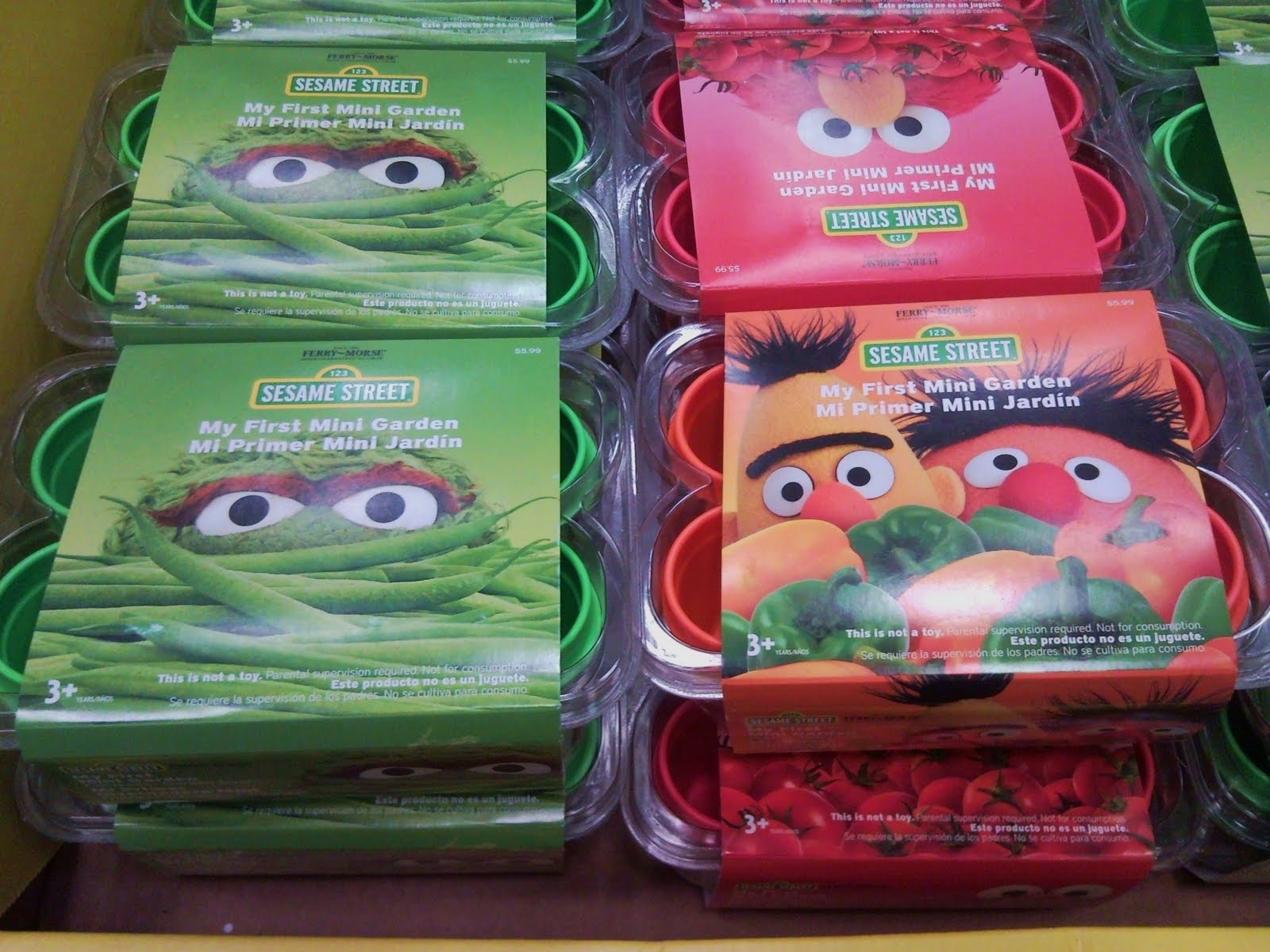
10) Sesame Street
Ask Michelle Obama - she did a guest spot on the show to talk about gardening.  I saw these yesterday in Lowes - I have to confess I haven’t used them. But if I had a preschooler, it’s a safe bet that I’d be buying some.


What works for you when gardening with kids?


Tuesday, January 12, 2010

Ten Things I Learned from Gretchen Rubin


Have you seen Gretchen Rubin’s blog “The Happiness Project” ?  I've follwed it for a little over a year now and was excited to learn that she was writing a book.  Now I had an actual professional reason for arranging to meet her in person!  What a relief (but not a surprise) to find out that not only is she extremely nice and down-to-earth, but open to doing an event with us! I read her book while on vacation and now see that the book holds the #2 spot on the New York Times bestseller list.


The book is part memoir, part self-help manual, and I can’t imagine anyone who wouldn’t find something useful in it. She says it many times: “Everyone’s Happiness Project is different” – so she's very clear that what works for her may not work for you. Some things, however -- like sleep -- are pretty universal. How can you be happy if you don’t get enough? Tired people are not happy.

Below are a few other tips that I’ve gleaned from her toolbox – most of them already tried and endorsed.


1. Show up for friends and relatives. How many times have you complained about going somewhere, but went anyway, and felt really glad you did afterwards? This happened to me last summer with a family reunion in Ohio. Most of these relatives I hadn’t seen since I was little. We had to travel miles and miles to get there (and there was more than a little grumbling), but it was great for my kids to meet some of their long lost relatives. I saw it as a way to honor my grandmother's memory by reuniting with her brothers and sisters. What surprisingly fun event have you been to recently?

2. Forget about results.  When I read blogs from other gardeners who are weighing and documenting the pounds and pounds of produce they’ve cultivated, it’s hard not to feel like I’m doing something wrong. When I remind myself that it’s the learning, the process, the trial and error, and even the failure that makes the experience enjoyable, I don’t feel as bad. And "Garden Amnesia,” as they say, “ensures eternal hope.” What results are you too preoccupied with?

3. Enthusiasm is a form of social courage.  I love Gretchen’s story about her friend who “came out” with her love for Barry Manilow.   I love bluegrass, clogging, and country step dancing. What “uncool” thing do you finally have the courage to admit that you like? You may find a kindred spirit.

4. Help people think big.  One of my friends is single and thinking about adopting a baby. This person would make such an amazing parent – and I tell her all the time. Even though she has major reservations and obstacles to tackle, it feels wonderful to encourage her. Are you helping anyone who is thinking big right now?

5. Wanting to be happy isn’t selfish. Research shows that happy people are more altruistic, productive, helpful, likable, creative, resiliant, interested in others, friendlier and healthier. Working on your own happiness has great potential to improve the lives of those around you.

6. Strong social bonds indicate happiness- for close long-term relationships, you need to be able to confide in others. You need to feel like you belong. Community theatre is awesome for creating these kinds of bonds. Is there a group that you’re happy to be a part of? People you can confide in?


7. Don’t take yourself too seriously. When I was a kid I had a poster with this motto on my bathroom door. As a teenager, I really think it helped me put things in perspective and worry less by reading it once a day.


8. Sing in the morning. Have you ever heard the sayings “When mama ain’t happy, ain’t nobody happy.” or “You’re only as happy as your unhappiest child” ? We forget that our moods are contagious and mornings set the tone for everyone’s day. I can always guage my son’s mood by his hum. (Though I can't be counted on to utter much of anything before coffee.)

9. Create an atmosphere of growth – start a blog. I am living proof that one doesn’t need any kind of special technology skills to start a blog. It’s been an amazing way to meet people with similar interests, get feedback (and yes, some criticism) on my projects and share updates with the Relatives in Far Flung States.  And as Gretchen reminds us, if you do something wrong on the blog, it's not a disaster.  If you haven’t started a blog yet, what’s holding you back??!

and finally this --maybe my favorite.....

10. Cut people some slack.  People's lives are more complicated than they seem, and situations that we're not aware of often influence actions that we might judge more harsely than we should.  (If you doubt this, you should read the short story "A Small Good Thing" by Raymond Carver - it completely changed how I look at human relationships.)  A forgiving heart is a happier one.


Do you have any happiness tips to share?

Gretchen Rubin is the author of several books, including the bestselling Forty Ways to Look at Winston Churchill and Forty Ways to Look at JFK. Rubin began her career in law, and she was clerking for Supreme Court Justice Sandra Day O'Connor when she realized that she really wanted to be a writer. Raised in Kansas City, she lives in New York City with her husband and two young daughters.

Gretchen is speaking at the 92nd St. Y on February 9.


Wednesday, September 30, 2009

Ten Things I Learned from Marie Winn

On Saturday a group of nature enthusiasts met at the 92nd St. Y to hear Marie Winn talk about animals and their nocturnal activity in Central Park. She's the author of the new book "Central Park in the Dark."Marie is a grand and gifted storyteller and has been following some of the creatures featured in her talk for many years - the most famous one being Pale Male, the red-tailed hawk who nested on a Fifth Avenue apartment building and had his romance with Lola chronicled in Winn's previous book "Redtails in Love," which was later made into a documentary film. Below are a few highlights of her talk.
"Pale Male" (c) D. Bruce Yolton

1)White Footed Mouse - This is probably the cutest rodent you'll ever see. Problem is, he's very hard to find. The only way they were discovered in Central Park was by analyzing owl pellets. Bone particles found in the owl droppings were taken to the Museum of Natural History to be identified.

2)Robins - Huge numbers of robins visit Central Park. In fact, Central Park has a higher density of robins per square mile than just about any place on earth. One of their favorite trees (at the north end of the Great Lawn) has been given the nickname "All Male Dormitory."

3)Common Grackle
As many as 1000 Common Grackles and starlings fly into 10 trees surrounding the Pulitzer Fountain near the Plaza Hotel (in front of Bergdorf Goodman) to roost overnight at dusk from summer to late fall. It's strange that so many birds arrive every evening with so few people noticing.

4) Owls
Some of the species of owls found in Central Park include Barn Owls, the Great Horned, Saw Whet, and Screech owls, which nest year round in the park's North End. Once, a Boreal Owl showed up near Tavern on the Green and and lots of birders made a pilgrimage to see him. (A "life bird" is a bird seen for the first time in one's life, and the Boreal was on many people's list of "life birds" still to be seen.) The love lives of these owls, their romances and fledgelings, are avidly monitored by the owl enthusiasts that frequent the park. (photo (c) D. Bruce Yolton)


5)Moths -
Many don't know that moths have two pairs of wings - the bright colors and eye-like markings on some of the underwings are used to scare birds away. The largest moth seen in Central Park was the rare Black Witch (shown at left) Others include the Small-Eyed Sphinx, the Plume, the Cabbage Looper, the Ilia, the Sweetheart, the Widow, the Wavy-Lined Emerald and Lobelia Dagger and many others. If you want to be a "Mother" (rhymes with author) don't wear "Off". You can attract moths to your yard with a special moth light.

6) Crickets & Cicadas
A snowy tree cricket is known as the weatherman of the bug world because you can find the approximate ambient Fahrenheit temperature by counting the number of his chirps in a 13 second interval, and then adding 40. These insects can sometimes be identified by their chirps. A cicada emerging from it's nymph shell is an amazing sight - you can actually see the fluid fill the wings.


7)Slugs - All slugs have both male and female organs. Watching them have sex is something everyone needs to do at least once in their life. They entwine around each other and their slime co-mingles to form a beautiful luminescent flower.

8)Stars - The Amatuer Astronomers Association gathers once a year for "Urban Starfest" on the Sheep Meadow. They bring their telescopes and invite the public to join them. Read more at on their website.

9)Bats - Bats find their prey by making high-pitched sounds and listening to the echos they produce when they bounce off their target - a process called echolocation. It's not easy to find bats at night, so people who want to see them often use a bat detector, a hand-held instrument that translates ultrasonic bat songs into frequencies people can hear. Bats typically emit sounds between 20 and 220 kilohertz.

10) A Coyote found in the Park was pursued by 25 people and had to be subdued with tranquilizers. The whole endeavor took close to 20 hours. The year-old coyote, nicknamed "Hal" died mysteriously after being held captive for a week. He stopped breathing while being tagged for release.


Marie speaks about many of these creatures as if they were her friends. Many of them have names and it's not unusual for their offspring can be doted upon as devotedly as grandchildren. People have set up websites and blogs devoted to following their favorites - Bruce Yolton's blog, http://www.urbanhawks.com/ is extraordinary and is updated regularly with bird video and photos.

Marie's website is at http://www.mariewinn.com/ -- find links there to lots more critter photos and resources.

Tuesday, August 11, 2009

10 Things I Learned from "Little Heathens"


Picking just ten things to highlight from Mildred Armstrong Kalish's wonderful memoir "Little Heathens" proved to be a challenge. The book is crammed with homespun anecdotes and wisdom that she gleaned from her years growing up on a farm in Iowa during the Great Depression. Although the subtitle of the book proclaims that there were "hard times," we come away with the impression that she lived in the ideal kind of world that we now crave more and more - a resourceful one of less waste, better food, and respect for animals, as well as each other. Despite her mother's "nonconformist lifestyle" and "loose routines," she also conveys a sense of true gratitude and appreciation for the unique way that she was brought up, and a desire to pass this appreciation on to future generations.

A few fun tips from Millie:

1)When making a pie crust:
To keep the bottom of a pie crust from getting soggy, beat one egg white until frothy, then spread a thin layer over the crust with fingers. Put in a 450 degree oven for 10 minutes, fill then return to baking.

2)When you have a splinter:
Break a fresh egg and carefully peel a small portion of the white membrane out of the shell. Place it on the splinter. Usually by the next morning it will be ready to be plucked out.

3)When comtemplating your place in society:
Remember the Protestant hierarchy: A Methodist is a Baptist who learned to read; a Presbyterian is a Methodist who went to college, and an Episcopalian is a Presbyterian who's made the social register.

4)When you get a bad bug bite:
Apply baking soda, black mud or earwax to a sting. If you get a canker sore, chew green pepper, but don't swallow, to relieve the smarting.

5)When you need wax:
Drain the honey from a comb and set the dry comb on some hardware cloth spread over an empty coffee can and place it in the sun. It might take a whole month to melt, but then you can mold the wax into a ball that can be held in the hand.

6)When you're coughing:
Place a flannel packet of hot, fried yellow onions and goose grease on the chest.

7)When your child has swallowed a bobbypin:
Have them eat sauerkraut. Since very young children do not readily digest it, the pin will become entangled in the undigested sauerkraut and pass safely through.

8)When you have lots of corn:
Make Corn Oysters: stir 2 cups of fresh corn kernals into a quarter cup of heavy cream. Mix in one tsp. baking powder, one tsp salt, and a dash of pepper with 3 tbsp. flour and add to corn mixture. Beat two large eggs and add. Fry, dropping by heaping spoonfuls, in oil or bacon drippings in a cast iron skillet.

9) When your hands are stained from shelling nuts:
Soak each hand in a large green tomato for about an hour.

10)When you only have one ball:
Repair as long as possible with a curved needle threaded with heavy linen cord waxed with beeswax. When it disintegrates take the inner core (which looks like a tightly wrapped ball of rubber bands), wrap in black tape and use it as a golf ball. To make a golf course, dig holes and sink coffee cans into them around the yard.


One of my favorite chapters was the one in which she described the forgotten tradition of making "May Baskets." The baskets were, ideally, made from old wallpaper sample books (having this kind of paper was considered a luxury.) The baskets were filled with treats and flowers and secretly hung on the doorknobs of favorite friends. At the end of the chapter Mildred wonders "Did this custom stop suddenly or did it just ebb away when no one was paying attention? Does anyone, anywhere hang May baskets anymore?" I wouldn't be surprised if Millie has inspired a few new traditions.

Hope you'll share additional "home grown" tips in the comments section if you have them!


Here's a link to a video of Millie talking about how her farm education has helped her throughout life.

Friday, May 8, 2009

10 Things I Learned About Ecological Intelligence


Psychologist Dan Goleman (“Emotional Intelligence”) and Stonyfield Farm Yogurt CEO Gary Hirshberg got together at the Y this past week to talk about new ways to think about being green -- focusing mostly on businesses and consumers. Below are a few things I learned from their talk, but you can read more in their new books, “Ecological Intelligence: How Knowing the Hidden Impacts of What We Buy Can Change Everything,” and “Stirring It Up: How to Make Money and Save the World.”


1) Walmart is progressive. Apple? Not so much. A lot is changing ecologically in the corporate world – businesses are starting to realize the consumer demand for responsible, green products – and respond to it. I’ve been boycotting Walmart since seeing “The High Cost of Low Price” a few years ago, so I was surprised to learn that Walmart is actually very high on the list of top companies that are changing their policies to become more green – and pressuring their suppliers to do the same. Apple, which has a very progressive image, is not at all green.


2) The goal is to “eat the cup”. Recycling is at the wrong end of the green chain. Rather than focusing on recycling waste, we need to think about producing less of it, which means buying less. The negative impact of what we buy usually overshadows any green activities that we do post consumption. Demand less packaging, greener (compostable, even edible!) packaging and more options to buy in bulk.


3) Soil replacement is key. Did you know that there is 50% less topsoil available for growing now than there was when America was discovered? The soil is being depleted -- use of nitrogen fertilizers creates runoff that kills off the estuaries and hurts the ecosystem. Practices like burning sugar cane fields put carbon into the air and wipe out organisms that contribute to soil fertility. Agribusiness needs to come up with inventive organic ways to build up soil without chemical fertilizers.

4) There are more obese people than simply overweight. Our nation has moved from being mostly overweight with a few obese people, to being mostly obese with a few who are overweight. 64% fall into one of these categories, the highest percentage ever. The way food is marketed in our country has had a big impact on this statistic.

5) We need to re-think waste and the myth of “away” (a neighboring state?) where we send it. Stonyfield farm created an anaerobic waste treatment plant that produces a gas that helps power their manufacturing. Although it was expensive to build, it ended up saving them half a million dollars a year.

6) Toxins are everywhere. Dan shocked us with the fact that a typical baby is born with 287 toxins, half of them being known carcinogens. This number has almost doubled in the last decade. Companies like Ikea are demanding formaldehyde and flame-retardant free materials. (But I still can’t find my daughter a flame retardant free cotton nightgown in any of the 167 stores in my local mall!) Many toxic chemicals that would no longer be approved are still in use because policy has ‘grandfathered’ them in.


7) We can find better choices at every price point. The green, organic products aren’t always the most expensive. Organic sugar is beginning to match white sugar in price because there is increased consumer demand and responsible business practices have proved themselves cost effective. Websites like goodguide.org can help you find a better product, whatever your budget.

8) Local is not always greener. Gary talked about an organic powdered milk from New Zealand that was obtained from grass fed cattle. A typical product has hundreds of industrial steps that impact the environment in some way. Consumers should demand that companies be more transparent about these steps and the carbon footprint of each of them.


9) The U.S. & China need to get together. Together, we create 42 percent of the world’s CO-2. A carbon tax isn’’t politically viable, but some kind of incentives for businesses should be put in place. China isn’t likely to sign on to any emission reduction targets unless the U.S. follows suit.


10) Nature inspires efficient design. Gary talked about how engineers, architects and designers can look to nature for ideas on how to design green buildings and products. Termite mounds have inspired efficient temperature regulation systems in buildings. Trains and planes are sometimes made like a bird’s beak to cut down on wind resistance. Molllusks take carbon out of the atmosphere to form their shells. How can we use this idea to our advantage?

Above all, the talk emphasized that as consumers, we need to investigate. It’s always good to research your purchases, but even better to avoid making them in the first place. When you do need to buy, here are some places to start:

Goodguide - ratings of natural, green and healthy products
Skindeep - cosmetics safety reviews and database
Climate Counts - vote for responsible companies with your dollars
Caring Consumer - find cruelty-free companies and products