Showing posts with label trees. Show all posts

Wednesday, November 7, 2012

Fall Update: Hurricane, Harvest and Hen Hierarchy


Now that Hurricane Sandy has passed, life is finally getting back to normal.  Our area was hit hard, but we were lucky – just a few tree limbs down and power disrupted for 5 days.  School was cancelled all last week and again Monday  – this made my kids very happy until they were reminded that they may still be attending in July to make up the extra days.  We’re still waiting in line for gas, but it seems like a small thing to endure when others in the NYC area are contending with such major losses.  There are at least 30,000 newly homeless in NYC right now and people are still having trouble getting around. We count our blessings with every news bulletin.

This was the last weekend for the community garden – everything needed to be out of the plots Nov. 4. I harvested lots of fennel, savoy cabbage, beets, Brussels sprouts, radishes, kale, lettuce, parsley and dill.  Plus a nice bunch of very fragrant sage given to me by a neighbor.     
I’m hoping some it holds out til Thanksgiving. 

An experiment – I took the fennel roots, cut the stalks, and replanted them in my perennial bed.  Since it’s one of the hardier vegetables, I’m hoping to get a head start on some for next spring.  German hardneck garlic and tulip bulbs were also planted this weekend. 

I don’t believe I’ve introduced you to my three new white chickens.   I adopted them from a man who decided he didn’t want to keep them through the winter.  Since they were originally purchased to amuse his grandchildren, I thought it only appropriate to name them after the kids: Hayden, Allison and Kaitlynn.   
Don't ask me which is which!
I was a little anxious about how they’d get along with the four current residents, especially Harley, a bantam Silver Spangled Hamburg, whose head is often plucked bare of feathers by the bigger girls.  She tried so hard to assert herself.  She was the first to confront the new hens – she fluffed up her feathers and boldly attacked.  They weren’t afraid of her though, and she’s still the little picked-on, bullied runt around here. 

It’s especially sad that she seems to be exiled from the coop.  It's like she has cooties.  The six others will typically squeeze into one coop, leaving Harley alone in the other one – even though 4 is supposed to be the maximum in one coop.  Poor Harley.  (She’s named after Harley Quinn, of “Batman” fame.  Guess who named her!?)  I’m trying to think of ways to give her more status and some roommates.    

I was so happy about the election results!  But would love to know why Prop 37 was defeated in California!  I find it very surprising because I thought they would be more progressive.  I heard there were ads.  If anyone knows where I can see one of these opinion-swaying ads, please leave me a link.  To learn more about the campaign for GMO labeling, visit www.justlabelit.org.

Monday, November 28, 2011

Leaving the Leaves

Did you know that there's a campaign underway to get us to stop raking up our leaves?  Rather, we're being encouraged to grind them into a finer mulch, or even just leave them where they are.  Ground up leaves that are mulched by a lawnmower are quicker to break down. They do wonders for the soil, adding organic matter, and helping replace what's lost through erosion. When left in garden beds, they protect roots and help retain moisture.

If enough people comply, municipalities will spend less time collecting and processing leaves, which saves them money.  See the video below that features Ann Holmes from the Greenburgh Nature Center in Westchester County.


With more than 50 trees on our property, the leaves piled up fast.  You can see that where the lawn ends, and the tree line begins, the leaves are at least a foot deep.

Here are some things I'm trying with my leaves this year...

The leaves are not being raked out of the beds until spring.  They're being left in place to protect the plants from winter abuse. 
They're just being left on the floor of the wooded areas.

We've created a pile behind the compost bin that we'll use to "feed" the compost throughout the year.  After food scraps or grass clippings are added to the bin, we'll throw in a few handfuls of leaves for good measure. 

The leaves on the lawn are being mowed over and ground up, then collected to be worked into the vegetable beds.


They're also being used in combination with wood shavings as litter in the chicken coops.  I think I'll try to use the ground up ones here in the future.


What do you do with your leaves?

Saturday, September 10, 2011

Healing Through Horticulture

Plants have so many roles in our lives, especially for those of us who garden. This week in particular, as we remember 9/11, I'm thinking about how plants have the power to heal as well as symbolize growth and survival. There's something about planting a seed that makes everything just a tiny bit better.  The Brooklyn Botanical Garden will even be waiving their admission charge tomorrow, on the 10th anniversary of 9/11, acknowledging this fact.

The Survivor Tree
I heard the story of The Survivor Tree for the first time this week. This was the only living tree found, stripped of it’s branches but still alive, on Ground Zero. It’s a Bradford Pear (Pyrus calleryana), a hardy but sometimes fragile variety often used in city gardens because of its compact, upright growth. The tree was removed, and nurtured in Van Cortlant Park in the Bronx, where it also pulled through several damaging storms.

Below is a photo of the memorial garden at Brooklyn Bridge Park. Volunteers planted 25,000 daffodil bulbs in plots that were shaped like the Twin Towers.  Although the garden is no longer there, this is such a perfect example of ways that a community can come together and heal through gardening.


Stacey's Garden
Stacey McGowan died on 9/11 and was a student at Valley Cottage Elementary when she was a little girl.  "Stacey's Garden" was planted in our school courtyard as a memorial to her. I didn't know Stacey, but I thought of her whenever I watered it. Her garden is the first thing that people see when they come into the school courtyard. It's lovingly tended by her mother and always has something in bloom.

A Hero from Nyack
Another member of our community who died on 9/11 is Welles Crowther.  He was known as the "Man in the Red Bandana." He was an equities trader and volunteer firefighter, only 24 years old, who helped a dozen people get out of the towers safely. Here is a link to an ESPN video about him. 


A couple of years ago, my daughter was asked to bring in an article about a 9/11 hero. She said half the class brought in articles about Welles. I will be wearing a red bandana tomorrow in his memory.

Monday, June 20, 2011

Help for Our Little Apple Tree

Back in 2007, we decided to plant an apple tree in our school courtyard.  It wasn't easy to get this idea approved.  There were lots of valid concerns.  Apples can be hard to grow organically, even for professionals (which we're not!)   With a little research though, I discovered that just about any pest or disease that affects an apple tree can be treated organically. 

There were also concerns that the abundance of fruit (we should be so lucky) rotting on the ground would attract rodents, and that the flowers would attract bees.  This may seem like a huge benefit considering the current crisis affecting honeybee populations, but for the school, and for the few children allergic to bee stings, it's a liability.

Since we have limited space, we ordered a "Three-in-one" grafted tree from a mail order nursery.  Since apple trees need to be planted near other apple trees in order to pollinate, grafting three trees together would allow three different varieties to pollinate each other within the same tree.  That's how we got away with only planting one. 

It took four years, but the tree finally developed fruit this year.   We were so excited!

However, now the apples have little worm (?) holes all over them. 


A sticky substance is coming out of the holes and rust-like fungus(?) is plaguing the leaves on one of the branches.  Most of the apples are falling off. 

I can't say that this tree has received too much attention in recent years -- it's definitely under-watered.  We've taken a wait-and-see approach, even with preventative treatments, because we want to be sure of what we're dealing with before we apply anything.

But now it's time to do something if we want to save it.  Some visiting experts from our local extension recommended that we submit an infected branch to their lab.  So that's the plan!  But I would also love suggestions from anyone who might have experience treating these kind of apple tree symptoms - preferably organically.  

Have you ever grown apples?

Thursday, December 9, 2010

An Alternative Tree

Inspired by some ideas in Bill McKibben’s book “Hundred Dollar Holiday,” we’re trying to scale back a little bit this year.  Much to the dismay of my kids, we started with the tree.  This meant breaking our regular tradition of cutting it down at a Christmas tree farm up in Warwick – a family event that usually ended up being an exhausting full day outing.  At first I tried to interest them in assembling some decorated branches – like these that I saw in Restoration Hardware.  I thought they were beautiful, but the kids were less than impressed. 

I thought about buying a small living tree, but they’re not inexpensive, I found.  Then one day when I was chasing chickens around in the backyard, trying to figure out why they don't have the sense to go back in their coop when a freezing wind is blowing, I saw this cedar and figured it was just about the right size - and price.   The S. man put on his red plaid.  

It’s not perfectly shaped.  I'd go as far as to call it Charlie Browny.
  

We do have a beautiful angel for the top to distract from the spindlyness.

Once the lights and ornaments are on it, it’s almost ready to pass for store-bought.  If you squint a little.  In the dark.

See also:
Christmas Tree Rejects

Monday, November 22, 2010

A Big Bloomin' Mess

Once again, I missed Garden Bloggers Bloom Day.  Not because I had no blooms!  It’s just that the blooms are being upstaged by the trees, the clear blue sky and that insanely beautiful golden light that hits the hills at dusk.  The blooms just aren’t the biggest attraction now.

Still, we got  French marigolds (Tagetes patula),

Canna (canna x generalis) "Cleopatra",

Nasturtium (tropaeolum)

Cilantro (Coriandrum sativum)


Roses (Hybrid tea - unknown cultivar)

Even a geranium (pelargonium) and petunia (petunia x hybrida) about to bloom.

Some herbs, cabbages and kale still poking along. 

Still harvesting the odd "watermelon" radish.  

Did I mention the leaves from the 40+ trees that are now blanketing the property?   We’re doing it a little different this year.  Instead of raking them up and packing them in 20-odd compostable bags for the town to pick up, I’m gonna blow them into the back of my “woods,” where I’m hoping they compost themselves, help keep the weeds down, and give the bugs a place to hide from the chickens. Maybe I’ll even shred them with the lawnmower and mulch my beds with them.  


But really.  Why move leaves around when I can play fetch with Miss. B??  Can you say "procrastination"....

Have you dealt with your leaves yet?

Monday, October 18, 2010

Fall Foliage Peak Week in Nyack

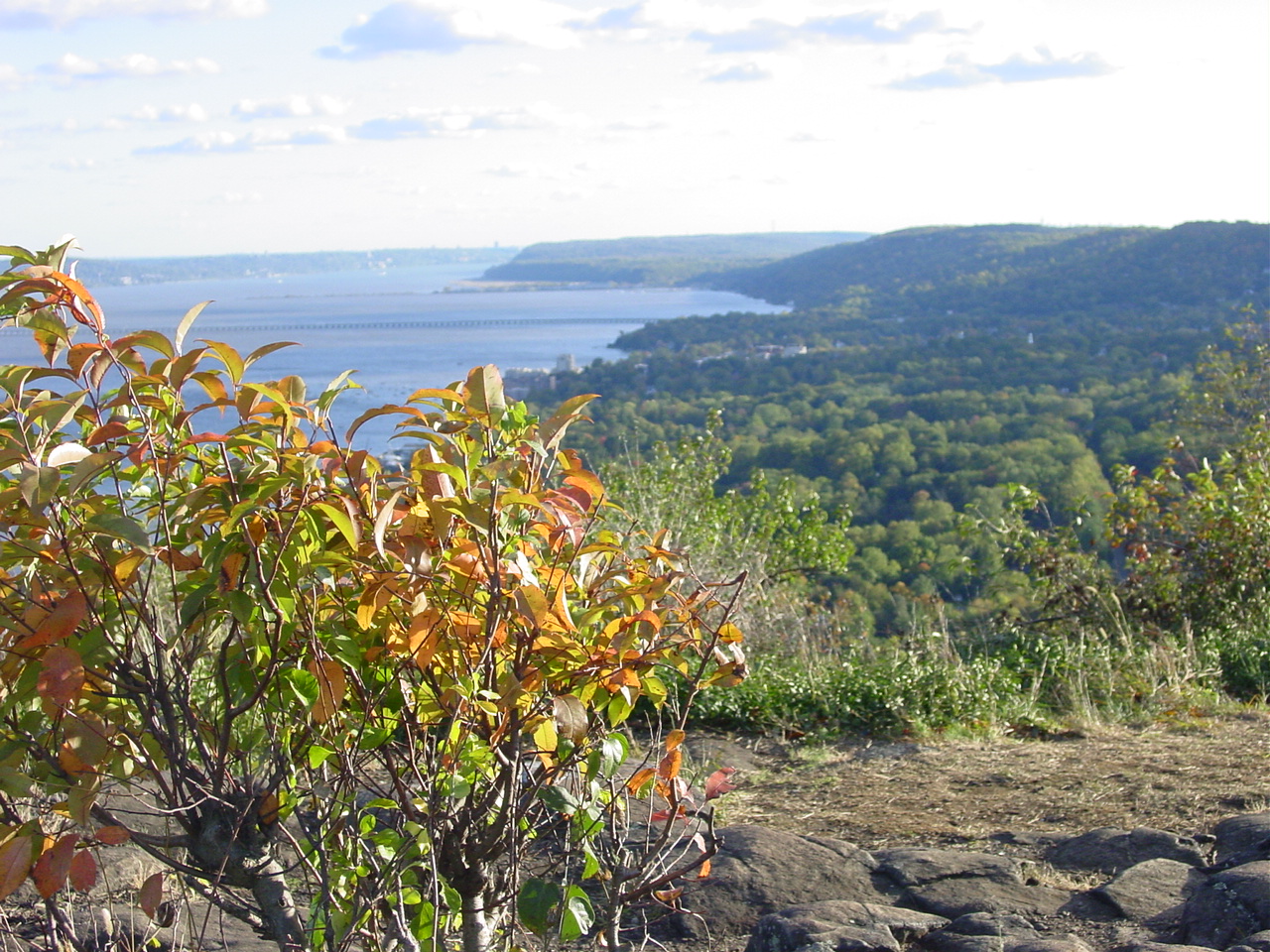
My friends and family down in Florida get a little jealous of us this time of year.  I’m convinced that we live in one of the most beautiful spots in the world during the last two weeks of October and can’t resist showing it off a little.  This map at Weather.com shows where fall foliage is peaking in different parts of the world, and it’s looking like this is just about prime time for Nyack and the rest of the Hudson Valley.  Here a few spots to scope it out nearby - follow the links for more info: 

1)  Hook Mountain – You can access the trail within Rockland Lake State Park or park along the side of the road on 9W and take a short, steep hike to the top of Hook Mountain for a large-scale view of the river and a good part of the Hudson Valley.  

2)   Nyack Beach State Park– at the end of North Broadway in Nyack is the entrance to this park, which features a path along the water’s edge.


3)   Mountainview Nature Park– travelling north on Rt. 303  just a little bit north of Rt. 59, you can find the entrance to this park by making a right just before the old Journal News building onto Greenbush, then a short left on Strawberry Hill.   If you hit KIA you’ve gone too far.  Such a gem and hard to believe it's 200 yards from the Thruway.

4)   Nyack Rural Cemetery – Park at the west end of Nyack Lumber on Rt. 59 and walk down the path.


5)  Buttermilk Falls State Park– entrance is on North Greenbush Road, and can also be accessed through the Rockland Center for the Arts’ nature trail.

6)  The Esposito Trail – There are lots of places in Nyack to catch this path.  I like to park on Brookside, and walk south toward the Thruway – it will take you all the way to Sparkill if you let it.

7)  Rockland Lake State Park -  Accessed easily by 9W, there is a 3.2 mile paved trail here, as well as trails that connect to Hook Mountain and Nyack Beach.

What about your own backyard?  Can I add a photo of your fiery plot or favorite spot?  Email it to me at nyackbackyard@gmail.com and I’ll add it to this post, which will be part of Dave’s Fall Color Project at The Home Garden blog. 

Previous Fall Color posts


Sunday, June 13, 2010

Ten Things I Learned from Dr. Susan Petro

If you ever have an opportunity to take a class or go on a "Botanical Walk" at Ramapo College with Dr. Susan Petro, don't even think about refusing. It can't exactly be called a nature walk because it was so much more -- history, literature, entomology, and ecology all had their moment.   There was even a culinary component. These are just a few highlights.

Our walk began with the Linden Tree in the parking lot.

1) Linden Trees (Tilia) are insect pollinated, so they can bloom AFTER the leaves appear.  Wind pollinated plants bloom before the leaves appear, because the leaves inhibit the flow of pollen. Tea, honey and scented oils are made from linden blossoms.  Our guide brought us sample of linden tea (which she served with some yummy homemade lemon madeleines!)

2) When White Clover (Trifolium repens) has been pollinated, the lower petals fold down.  That sends a message to pollinators not to bother with this one.


3) MADCAP HORSE is an acronym that helps you remember which trees and shrubs have opposite leaves so that you can identify them.
M  = Maple
A  = Ash
D = Dogwood
CAP = Caprifoliaceae - viburnums and honeysuckles
HORSE = Horse Chestnut

4) Spruce (picia) v. Fir (abies)- One way to identify conifers is to pull off a needle.  If it is a single needle (rather than several in a package) it is most likely a spruce or fir.  A spruce needle has 4 sides- "S" is for "Square" and "Spruce."  A fir needle is flat.  "F" is for "Flat" and "Fir."  You'll be able to tell the shape by rolling the needle between two fingers.

5) One legend says that Queen Anne's Lace (daucus carota) is so named because Queen Anne, a champion lacemaker from Denmark, challenged her ladies in waiting to a contest to see who could make the prettiest lace, and Queen Anne, being the queen, won. 

Queen Anne, Queen Anne, has washed her lace
(She chose a summer's day)
And hung it in a grassy place
To whiten, if it may.

Queen Anne, Queen Anne, has left it there,
And slept the dewy night;
Then waked, to find the sunshine fair,
And all the meadows white.

Queen Anne, Queen Anne, is dead and gone
(She died a summer's day),
But left her lace to whiten in
Each weed-entangled way!

By Mary Leslie Newton

6) Sassafras- (sassafras albidum) has 3 different leaves: One that looks like a mitten, one with three lobes, and one a simple oval.  The root was used to flavor root beer until it was discovered that the distilled oil causes cancer, and it was banned by the FDA.

7) Lichen
"Algae, you're a fungi, I think I've taken a lichen to you...."  Lichen are both algae and fungi living together.  Lichen are harmless to trees and very sensitive to air pollution.

8) St. John's Wort (Hypericum perforatum) produces an oil that, when consumed by cattle, makes them photosensitive.  When the plant overtook some California farmland, the cattle started getting terrible sunburns, and a special beetle had to be introduced to get it under control. 

9) Which Maple (acer) is this?  Squeeze the tip of the leaf twig. If a white milky extract comes out, it's a Norway Maple.  If none, it could be a Red or Sugar Maple.  Red Maples have teeth along the edge.  Sugar Maples do not.  The shape of a Red Maples is like a cat in a ski cap. 

10) Milkweed (asclepias) have a little slit on the side that can trap a pollenator and force him to carry hunks of pollen out with her when she leaves.

Well, that's 10, but I love this flower called "butter and eggs" (linaria vulgaris) or toadflax so much! the center has a darker yellow "runway" to alert insects to where the pollen is.  This flower is also known as a "baby snapdragon" and yes, they have a little jaw that opens and closes with a gentle pinch.  I just had to show you a picture of it.

Dr. Petro's talk stressed the importance of planting native species when given a choice, and the role of native plants in our ecosystem.  It will be very hard to walk through the woods, or even my backyard now without recalling these valuable lessons, and feeling grateful to have had this opportunity.